

Through media, conferences, and community initiatives, I work to destigmatize mental health and make evidence-based knowledge accessible to everyone who needs it.
I strongly believe that psychology shouldn’t live only in academic journals, research labs or behind clinical doors. Real change happens when evidence-based knowledge becomes accessible to everyone who needs it, when research findings transform into practical understanding, when complex science becomes clear guidance, and when professional expertise meets everyday struggles with clarity and compassion.
Through media collaborations, public writing in simple language, and community engagement, I work to destigmatize mental health, make evidence-based knowledge accessible, and advocate for those whose struggles often remain invisible. Simply put I work to bridge this gap: translating years of research and clinical experience into insights that resonate, inform, and empower. Whether writing for Ireland’s national broadcaster, contributing to professional psychology publications, or speaking on knowledge exchange events and Greek media about mental health and social inclusion, my commitment remains the same – to make psychological science not just rigorous, but genuinely useful. Each presentation is tailored to the specific audience, with the aim of fostering meaningful communication, offering clear and useful information, and empowering people through new knowledge, empathy, and a broader understanding.
Because knowledge that remains hidden can’t benefit the people it’s meant to serve. My work is about translating it into something usable, accessible, and supportive. That creates pathways to understanding, reduces stigma, and reminds people struggling in silence that they’re not alone.
As a psychologist and psychotherapist with extensive clinical and research experience, I regularly contribute to media and publications to make psychological science accessible and help reduce stigma around mental health. My aim is to promote mental health, inclusion, and access to reliable, understandable knowledge. I’ve shared articles, interviews, and expert commentary with Greek and international outlets, contributing to public conversations on mental health, social inclusion, and holistic care.
My work has been featured across a range of respected platforms and media outlets, including RTÉ Brainstorm (Ireland’s national broadcaster), The Psychologist of the British Psychological Society, Psychology Now, one of Greece’s leading psychology platforms and the Ideas in ALL series from Maynooth University’s ALL Institute. I have also spoken at knowledge exchange events and appeared on television to discuss social solidarity and mental health, as well as on various radio programs exploring topics such as resilience, wellbeing, and social inclusion.
Dementia affects 57 million people and their families worldwide, yet it remains one of the most feared, misunderstood and stigmatised conditions of our time. Too often, the information available is either too clinical to be accessible or too distressing to invite genuine engagement. That is precisely what makes Dr Sabina Brennan’s dementia films so remarkable and why I was glad to contribute to making them available to Greek-speaking audiences.
I believe that evidence-based knowledge about dementia should be available to everyone, not just those who speak English, not just those with a clinical background, and not just those who already know where to look. That belief is what led me to collaborate with Dr Sabina Brennan, neuroscientist, health psychologist, and researcher at Trinity College Dublin, in making these outstanding animated films accessible to Greek-speaking audiences for the first time, by translating the transcripts and adding Greek subtitles throughout the series.
These films were developed to increase public and professional awareness around brain health, memory loss and dementia, while addressing the stigma and fear that can accompany a dementia diagnosis. Each film answers a key question about brain health and dementia that people most commonly ask; questions about how memory works, when to see a doctor, what an Alzheimer’s diagnosis means, and how to stay connected to community. Whether you are living with dementia, caring for someone who is, working in healthcare, or simply want to understand what dementia really means these films offer something rare: science made simple, comprehensible and human. These films have been viewed in 146 countries and research has demonstrated their effectiveness in terms of knowledge acquisition, fear reduction, and intention to change behaviour. Watch them, share them, pass them on because dementia knowledge should have no language barrier.
I Have Trouble Remembering Things Does That Mean I’m Getting Dementia?
Dementia Caregiving: How Can I Manage Challenging Behaviour?
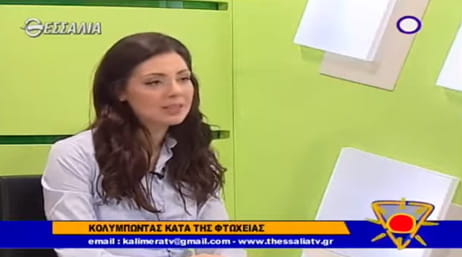
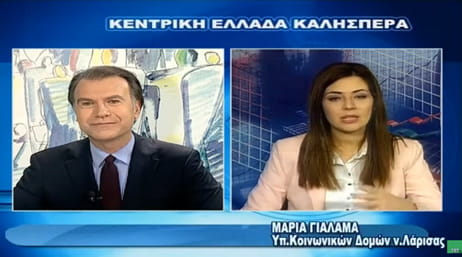
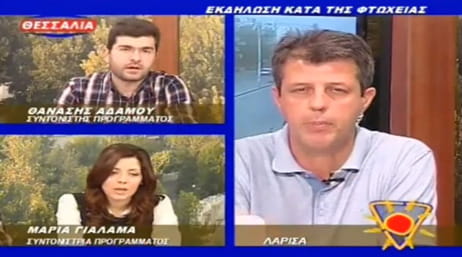
I have appeared on television programs as a psychologist, offering commentary and analysis on mental health and current social issues.

I regularly contribute to radio programs, discussing psychology, mental resilience, social cohesion, combating stigma and social exclusion, and supporting vulnerable groups. These interventions aim to make mental health accessible, humane, and evidence-based for broad audiences.
As a researcher and clinician, I believe the most powerful knowledge exchange happens when patients, healthcare professionals, policy makers and researchers share the same room, because real transformation begins when all these voices are heard together.
Knowledge Exchange (KE) events, such as seminars, workshops and conferences, are spaces where people come together to share what they know and learn from one another. Through workshops, talks, and collaborative discussions, researchers, professionals, policymakers, and community members meet as equals to exchange ideas and turn research into something that can genuinely help society. These events spark real dialogue, turning knowledge into something living, shared, practical and useful in everyday life.
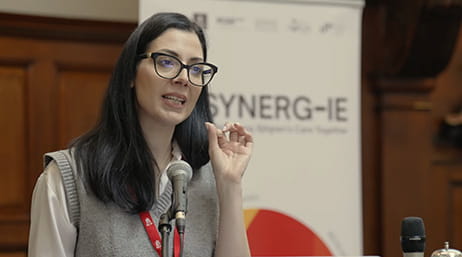
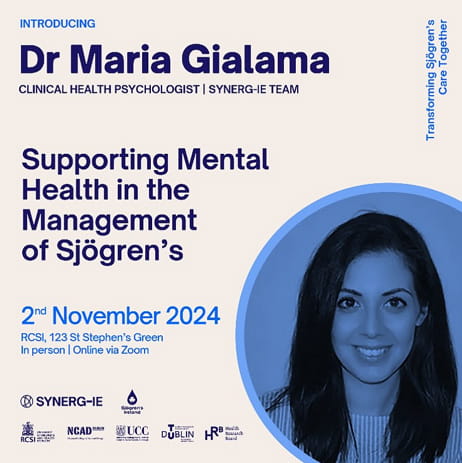
Sjögren’s disease affects millions of people worldwide, yet it remains one of the most misunderstood and underdiagnosed autoimmune conditions. Its symptoms, such as debilitating fatigue, chronic pain, cognitive difficulties among others, are largely invisible to the outside world, making the experience of living with it not just physically exhausting but profoundly isolating. In November 2024, I was honoured to participate as a psychologist and postdoctoral researcher in the SYNERG-IE program, at the first international knowledge exchange event dedicated entirely to transforming Sjögren’s care, bringing together rheumatologists, mental health professionals, researchers, and crucially, those affected by the condition. The event “Transforming Sjögren’s Care Together: Rheumatology and mental health perspectives” took place at the Royal College of Surgeons Ireland and marked a significant step toward the kind of integrated, holistic care that people with complex chronic conditions deserve.
My presentation, “Supporting the Mental Health of People Living with Sjögren’s Disease“, focused on what’s often left unspoken in clinical encounters, the emotional weight of living with an invisible illness. I explored practical strategies for mental wellbeing alongside the daily challenges the disease brings and made the case for why recognizing both the physical and emotional dimensions of patients’ experiences isn’t optional, it’s essential.
https://www.youtube.com/watch?v=3vqrHLAb6ks
The response from participants was deeply moving:
“The talk on mental health was excellent and useful for any situation in life. Thank you for the information.”
Such reactions reveal something important; when we speak honestly and acknowledge invisible struggles (or the elephant in the room), the insights resonate far beyond any single diagnosis. Mental health knowledge, when shared openly and accessibly, becomes a resource for everyone. Such events are where real change begins, where patients feel seen, heard and understood, clinicians expand their understanding, and researchers discover what their work truly means in the lives of real people experiencing real challenges. The event was an important opportunity for knowledge exchange, community empowerment, and creating bonds between patients, health professionals, and researchers, promoting awareness and sensitizing the public around issues concerning the visibility of patients with invisible disabilities.
Collaborations with organizations promoting care, inclusion, and awareness
As a psychologist and psychotherapist specializing in clinical health psychology, I collaborate with professional associations, patient organizations, and community groups working toward empowerment, information sharing, and support for people living with chronic conditions or psychosocial challenges. My talks and presentations focus on practical, evidence-based, and person-centred approaches, aiming to strengthen mental health, social participation, and quality of life.
The pandemic didn’t just disproportionately affect people with dementia and disrupt their daily lives, it severed the social connections that research shows are fundamental to their wellbeing. Suddenly, all the activities, social gatherings, and human contact that gave shape and meaning to their days disappeared. The question wasn’t just “how do we cope?”, tt was “how do we reimagine care when everything we knew has changed?”
Alzheimer Cafés exist precisely for moments like this. These warm, informal, and welcoming spaces bring together people living with dementia, their caregivers, families, and professionals not for clinical assessment, but for something equally vital: human connection, shared experience, and the quiet power of togetherness.
At the Glasnevin Virtual Alzheimer Café, I presented “Dancing After Distancing? Rethinking Dementia Treatment and Care Post-COVID” an exploration of how the disruption of the pandemic could become an unexpected catalyst for more creative, holistic, and genuinely inclusive approaches to dementia care. The presentation asked a deceptively simple question: What if we stopped focusing only on what’s been lost, and started celebrating what remains?
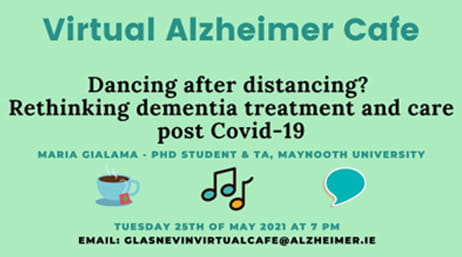
I explored how dance and creative movement offer far more than physical activity. They’re pathways to creative expression, joy, reconnection and meaningful engagement when words become difficult to find. How mindfulness practices help people stay anchored in the present moment rather than lost in confusion about the past or fear of the future. And how the pandemic, for all its devastation, revealed something important: that human connection isn’t supplementary to dementia care. It’s the heart of it.
The talk was received with warmth and enthusiasm, sparking conversations about what truly person-centred dementia care can look like, not despite cognitive decline, but in full recognition of the whole person who remains.
The Irish Association of Creative Arts Therapists represents one of the most profoundly human corners of mental health care, where dance, movement, visual art, drama, and music become ways for people to express themselves, reconnect and eventually heal. IACAT exists because some of the most powerful therapeutic moments happen not only through words, but through the languages of the body and the imagination, those creative languages that help us externalise suppressed emotions, feel seen, accepted and understood.
Being invited to speak at IACAT‘s Annual General Meeting in 2020 was a true honour, not only because it brought together the leading professionals and researchers in creative arts therapies, but because it represented a recognition of something I deeply believe, that psychology and the arts aren’t separate disciplines. They’re inseparable partners in the work of human healing, each offering ways for people to express, connect, and make sense of their experiences.
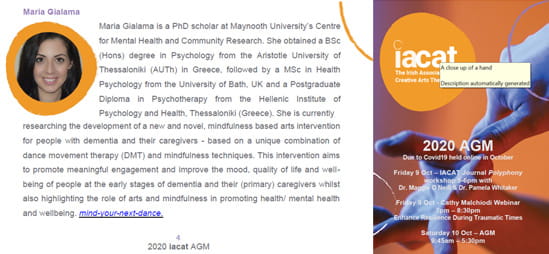
My presentation explored the profound therapeutic power of creative expression—how movement, art, and music can reach places that words sometimes cannot, particularly for people whose verbal communication has been affected by illness, trauma, or cognitive change. I highlighted how integrating creative arts approaches within psychological care doesn’t dilute clinical rigor, rather it deepens it, opening new pathways to connection, self-expression, and genuine transformation.
My presentation explored the profound therapeutic power of creative expression—how movement, art, and music can reach places that words sometimes cannot, particularly for people whose verbal communication has been affected by illness, trauma, or cognitive change. I highlighted how integrating creative arts approaches within psychological care doesn’t dilute clinical rigor, rather it deepens it, opening new pathways to connection, self-expression, and genuine transformation.
The conversations that followed reinforced something the research consistently shows: when we create space for creativity in therapeutic settings, we create space for humanity. And that safe, non-judgmental, expressive space can be profoundly empowering, transformative and healing.




As a psychologist and researcher, I actively participate in national and international and European conferences, symposia, and research seminars, presenting my clinical and research work and contributing to dialogue around health psychology, clinical psychology, psychotherapies, clinical practice, and innovative, multicomponent interventions.
My presence at conferences, seminars, and symposia strengthens interdisciplinary collaboration, promotes knowledge exchange between researchers, health and care professionals, and patient communities, and highlights the value of holistic, person-centred and evidence-based care.
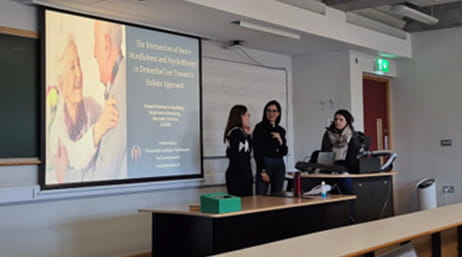
What does it look like to bring together dance, mindfulness, and psychotherapy in a single intervention for people living with dementia? This was the question at the heart of my doctoral research and the subject of my invited presentation at Maynooth University’s Psychology Research Seminar Series.
Research seminars are where ideas are rigorously examined, questioned, and refined. Being invited to present here meant bringing my doctoral work before an audience of peers, researchers, and clinicians, a process that both challenges and deepens understanding.
My presentation “The Intersection of Dance, Mindfulness, and Psychotherapy in Dementia Care: Toward a Holistic Approach” explored the connection of three powerful approaches in dementia care: creative movement and dance as means of expression and communication when words become difficult to find; mindfulness as a tool for present-moment awareness and emotional regulation; and psychotherapy as the grounding framework that holds it all together, uniting body, mind, and emotion in a coherent, compassionate approach to care.
Notably, what emerged was a different way of thinking about dementia support, one that shifts the focus from loss to possibility. Instead of asking, “What can this person no longer do?” we begin to ask, “How can we create conditions where they can still engage, enjoy themselves, and reconnect with their bodies and their world?”
The response from the academic community affirmed what the research already suggested: that when we honour the whole person- their creativity, their emotional life, their capacity for connection- we find possibilities that deficit-focused approaches simply can’t see.
The British Psychological Society’s annual conference brings together some of the most rigorous minds in psychological science, comprising a space where ideas are tested, evidence is scrutinized, and the field moves forward.
Presenting at the Northern Ireland Branch conference in Belfast in 2019 was an opportunity to contribute to that dialogue on two fronts that I care deeply about: the mental resilience of young people navigating increasingly complex worlds, and the search for humane, non-pharmacological ways to support people living with dementia. https://x.com/NIBPS/status/1116284376109735937?s=20
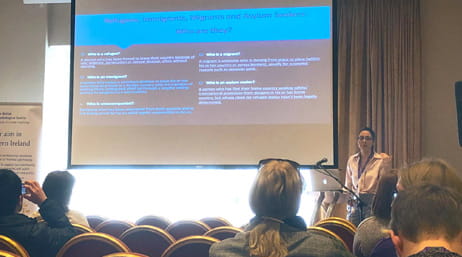
The first strand of my presentation explored what builds genuine psychological resilience in young people, not the superficial “bounce back” narrative, but the deep, research-informed understanding of what helps young people face adversity, uncertainty, and pressure without losing themselves in the process.
The second strand challenged the prevailing reliance on pharmacological approaches to neuropsychiatric symptoms in dementia, including agitation, depression, anxiety, sleep disturbance among others while making the case for evidence-based alternatives that address the whole person rather than simply managing symptoms. Movement, mindfulness, creative engagement, and genuine human connection emerged not as “nice to have extras” but as powerful interventions in their own right.
These presentations were also great opportunities for international connection; meeting researchers, clinicians, and academics whose work intersects with mine, and contributing to the growing body of evidence that humane, person-centred care is essential and as effective.
Research shapes care. But research without patient voices shapes the wrong care. This was the guiding principle behind the All-Ireland Multiple Sclerosis Research Network Symposium and the reason I was proud to be included as a member of its organizing committee.
Multiple Sclerosis is a condition that touches every dimension of a person’s life, physical, emotional, relational, professional. Yet too often, the research agenda is shaped by what scientists find interesting rather than what patients find essential and need answers. The AIMS-RN Symposium set out to change that, deliberately building patient participation into the architecture of the event itself.
The symposium brought together researchers and clinical scientists from across disciplines, people living with MS and their advocacy organizations, healthcare professionals, and representatives from MS Ireland, thus creating a genuine dialogue where each perspective was valued not despite its difference from the others, but because of it.
The program reflected this polyphony: cutting-edge presentations on biomedical research and emerging therapeutic approaches sat alongside sessions on psychosocial interventions, empowerment programs, and innovative digital tools that support daily life with MS. Contributing to this event reinforced something I carry into all my work, that the most meaningful science happens at the intersection of expertise and lived experience, where rigorous evidence meets the complex reality of a person’s daily life. (The All-Ireland Multiple Sclerosis Research Network (AIMS-RN) 2025 Symposium).


“The most meaningful knowledge exchange doesn’t happen when an expert speaks and simply delivers information to a passive audience. It happens when the right ideas meet the right people at the right moment and something inside them shifts“.
I’ve spent over fifteen years working at the intersection of research, clinical practice, and lived experience. I’ve presented at national and international conferences, intimate community gatherings, seminars and workshops, spoken to academics, professionals and patients, appeared on national media, academic, clinical and in local community centres. What I’ve learned is that what matters most is the question: What does this audience most need to hear, feel, or understand differently?
That question guides every presentation I give. Whether you’re organizing a professional conference, a patient awareness event, a community workshop, or a media appearance, I bring the same commitment: to make complex ideas accessible, to speak honestly about what the current evidence shows, and to leave your audience not just informed but genuinely moved to think, feel, or act differently.
If you’re organizing an event, planning professional training, developing a community initiative, or looking for expert media commentary, I’d love to hear from you.
Tell me about your audience, your goals, and what you hope people will take away and we can design something that genuinely serves them.
Before the event: I invest time understanding your audience, their needs, and what you hope the event will achieve. Every presentation is carefully tailored to your audience’s needs in response to your specific context.
During the event: My presentations are interactive, engaging, and designed to spark genuine dialogue rather than passive reception/ listening. I combine scientific rigour with personal narrative, research evidence with clinical insight, and professional expertise with the kind of honesty that comes from having been on both sides of the therapeutic relationship.
After the event: The conversation doesn’t have to end when the session does. I’m happy to discuss follow-up resources, collaborative opportunities, or ongoing engagement with your organization or community.
My speaking and training sessions are designed to inspire, inform, and engage audiences of all kinds—from professional conferences to community workshops. Each experience is carefully tailored to meet your audience’s needs and leave a lasting impact.
Over the years, my presentations have reached remarkably diverse audiences and that diversity is something I deeply value. From patient advocacy organizations and hospital clinical teams to academic departments and international research conferences, from schools and universities to community organizations, NGOs each audience brings its own questions, needs, and perspective. What remains constant across all of them is the commitment to making psychological knowledge genuinely useful. Good ideas, communicated with clarity and care, have the power to reach anyone. That’s what I aim for in every room I enter.
“Let’s Discuss Your Event”
I endeavour to respond to all speaking inquiries within 48 hours.
Email: maria.gialama@bath.edu
Phone: (+30)231 511 32 90 – (+30)6983116404 – (+353)830458500
“I believe that when we share knowledge generously, speak honestly about what it means to struggle, and create spaces where people feel genuinely seen, we don’t just inform. We contribute to healing. That’s what every presentation I give is ultimately about.”
— Dr. Maria Gialama
On this page, you can find information that may help you better understand health, mental health, mental illnesses, and how they interact. It is important to be aware of what recent research findings show, as well as the forms of psychological support and care that are available. If something is causing you concern or distress, it is advisable to speak with a qualified mental health professional.
© 2026 · Maria Gialama. Desiged by Protasi™ · Created & Powered by Creart™.