


Psychotherapy has been defined as “the informed and intentional application of clinical methods and interpersonal attitudes, based on established psychological principles, with the purpose of helping people modify their behaviours, thoughts, emotions, and/or other personal characteristics in directions they consider desirable.”
In essence, psychotherapy (also called talking therapy) is a conscious, collaborative, and evidence-based process that, through conversation, helps individuals understand themselves more deeply; their thoughts, emotions, and reactions. Through a safe and supportive therapeutic relationship, individuals have the opportunity to process experiences, recognize patterns that no longer serve them, and develop new ways of thinking and behaving that enhance their wellbeing (Ladmanová et al., 2025).
Psychotherapy isn’t a process that’s “done to” or “for” someone, but an active collaborative relationship. The client participates meaningfully, while the therapist offers understanding, support, and evidence-based interventions. The goal is empowerment, self-awareness, and creating lasting changes that have meaning for the person themselves. Based on contemporary psychological principles, psychotherapy primarily uses conversation and interaction to understand and treat dysfunctional emotional reactions, ways of thinking, and behavioural patterns (American Psychological Association, 2025).
It’s intended for adults and adolescents who wish to improve their mental health, address challenges, or cultivate a more meaningful relationship with themselves.
Counselling is a safe, structured, and confidential collaboration between the therapist and the client, aimed at strengthening mental health, self-awareness, and processing difficulties. Its goal isn’t to give advice, ready solutions, or guidance, but to facilitate someone in deeply exploring what troubles them in their daily lives, better understanding themselves, and developing coping strategies that best suit their own needs and values.
Throughout the process, the client participates actively: setting goals, processing thoughts and emotions, and learning to respond to challenges with greater balance, care, and awareness. Counselling can be particularly useful during periods of intense anxiety or emotional pressure, in relationship difficulties (family, friendship, professional), in moments of confusion or life direction changes, as well as when there are issues that are difficult to discuss with one’s immediate environment (friends, relatives, colleagues, or teachers).
The process occurs with respect and dignity, structure, confidentiality, and discretion, leading to the creation of a stable framework of safety and trust. This allows clients to explore their inner worlds and receive support to make choices that reflect what they truly need. Clients remain active throughout the process and receive support to make decisions that suit them best.
Often this is a short-term intervention, while in some cases therapy can extend to cover more complex difficulties.
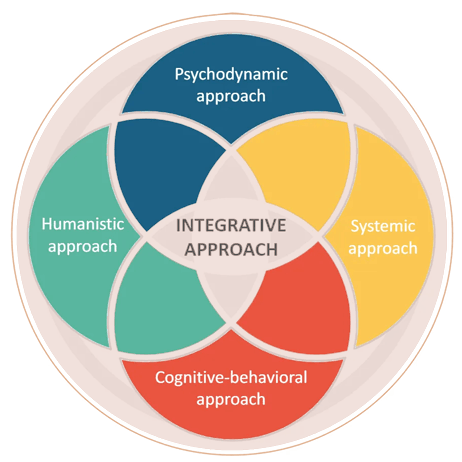
There are many types of psychotherapy, the main ones being Psychodynamic psychotherapy, Cognitive Behavioural therapy (CBT), Humanistic therapy, and Integrative psychotherapy, which combines elements from various approaches. The common goal of all forms of psychotherapy is improving someone’s mental health and quality of life.
Integrative Psychotherapy combines elements from different therapeutic schools, namely psychodynamic, cognitive, behavioural, Gestalt, systemic, body-centred approaches, and object relations theories, through a developmental and biopsychosocial framework. It doesn’t apply “one method for all” but adapts interventions to each person’s needs, personality, and life stage.
Integrative psychotherapy is a contemporary, person-centred, and personalized approach that views the person as a whole: thought, emotion, body, behaviour, and spirituality constitute interconnected aspects of the same experience. It recognizes that each person is unique and needs a therapeutic approach that responds to their own needs, pace, and life phase.
Rather than limiting itself to a single therapeutic model, it draws elements from different approaches and combines them flexibly, in evidence-based ways. Thus, therapy adapts to each person’s particular challenges, sensitivities, and capabilities. Each life stage brings with it new needs, crises, challenges, and opportunities for learning and evolution, and therefore, the integrative approach acknowledged and honours this dynamic, creating a space where clients can develop with authenticity, coherence, and deeper connection with themselves.
Its goal is the integration of different aspects of self, functionality, and wellbeing at intrapsychic, interpersonal, and social levels. It’s a therapy that cultivates wholeness through continuous personal development, knowledge, and authentic human connection, so clients acquire greater authenticity, flexibility, and ability to relate to the world with more presence and freedom.
At the same time, Integrative Psychotherapy is based on what research now calls “common therapeutic factors”: the therapeutic relationship, empathy, hope, sense of safety, and authentic connection. These factors have proven more decisive for change than any isolated technique. Thus, therapy becomes a collaborative process where the client participates actively, while the therapist adapts interventions based on scientific knowledge, clinical judgment, and the person’s needs, creating the necessary conditions in a space where change can happen safely, sustainably, and meaningfully (Zarbo et al., 2016).

I hold a psychologist’s professional license (686/19/1/2009) and am a member of the British Psychological Society (BPS). My practice is based on evidence-based approaches and a solid ethical framework that ensures the care you receive is professionally sound, safe, and adapted to your needs.
I’m committed to offering an environment of confidentiality, respect, and inclusivity, where you can speak freely, without judgment, and feel unconditional acceptance.
My work is guided by the four fundamental principles of the BPS:
These principles constitute the foundation of my therapeutic identity and shape a space where trust, safety, and meaningful change can truly develop.
As a psychotherapist, my goal is to support the exploration, development, and empowerment of your personal resources. I create a space of careful listening, empathy, safety, and acceptance, where you can speak openly about what troubles you, whether concerning relationships, anxiety, psychosomatic symptoms, or difficulties, problems, and challenges you feel are limiting you.
My approach is personalized, non-directive, and adapts to your needs and experiences. You know best and you are the expert on your life, and together we explore what lies behind your thoughts, reactions, emotions, and possible psychosomatic, invisible, or medically unexplained symptoms among other challenges and difficulties. We work together to recognize your strengths as well as weaknesses and build new ways of connecting with yourself and significant others.
When you work with me, you benefit not only from my extensive clinical training but also from a broad professional background grounded in adaptability, sensitivity, inclusion, and evidence-based care. My approach combines knowledge, experience, and humanity to create a space where your needs are truly heard and therapy adapts to you.
My goal isn’t to give you ready solutions (I don’t have them anyway!), but to support you in discovering your own; ones that truly fit your life, allow you to be authentic and move forward with greater stability, awareness, self-trust and trust in your choices, and freedom.
From our first contact through every session, you can expect consistent and reliable support, clear and empathetic communication, professional warmth, and respect for your time and autonomy. My goal is to offer high-quality psychological care that honours your experience and supports meaningful change and personal growth.
A large international study published in The Lancet Psychiatry (Ladmanová et al., 2025) gathered the experiences of nearly 3,000 people who underwent individual psychotherapy in 24 countries. What’s striking is that the people receiving therapy themselves spoke about what changed in their lives.
What they reported as benefits:
In conclusion, the study shows that psychotherapy isn’t only about reducing symptoms. People describe it as a process that helps them understand themselves better, strengthen their relationships, and live with a greater sense of fulfilment. Beyond relieving anxiety or sadness, therapy cultivates self-awareness, empowers autonomy, and strengthens the capacity for meaningful connection with others. In other words, psychotherapy isn’t only about addressing difficulties but developing a more integrated, conscious, and connected way of life.

The first session is an opportunity to get to know each other and understand what brings you to therapy. We discuss your request, take a brief history, and together shape the framework of our collaboration. The request may concern difficulties affecting your daily life, such as relationships, anxiety, performance, or quality of life, or the need for personal development and self-awareness, even without the presence of any specific “problem.”
Therefore, in this session we establish the basic principles of our collaboration: the prerequisites, our mutual obligations, and expectations of the therapeutic relationship. This framework helps us build a relationship based on equality, mutual respect, and commitment, creating a safe space for personal empowerment and evolution.
Individual sessions last 50 minutes and occur on a stable weekly schedule (unless otherwise agreed).
In case of cancellation, at least 24 hours’ notice is needed; otherwise, the session is charged. Similarly, if there’s cancellation on my part without timely notice, the next session is offered without charge.
Start and end times are predetermined and aren’t extended in case of delay. During the session, it’s important to focus and have authentic presence, without distractions (e.g., mobile phone, food, smoking).
If you wish to space out meetings or complete therapy, it’s important to discuss this openly so the cycle of our collaboration closes smoothly and supportively.
Recognizing the importance of accessibility, I offer online sessions so you can receive quality psychological support wherever you are. Online therapy offers flexibility and adapts to your daily life needs while maintaining a stable and meaningful therapeutic relationship. It’s a way of working that combines comfort and consistency without reducing connection quality or therapeutic process depth.
Payment can be made by bank transfer or cash, depending on what suits you best.
Fees are the same for both online and in-person sessions.

On this page, you can find information that may help you better understand health, mental health, mental illnesses, and how they interact. It is important to be aware of what recent research findings show, as well as the forms of psychological support and care that are available. If something is causing you concern or distress, it is advisable to speak with a qualified mental health professional.
© 2026 · Maria Gialama. Desiged by Protasi™ · Created & Powered by Creart™.